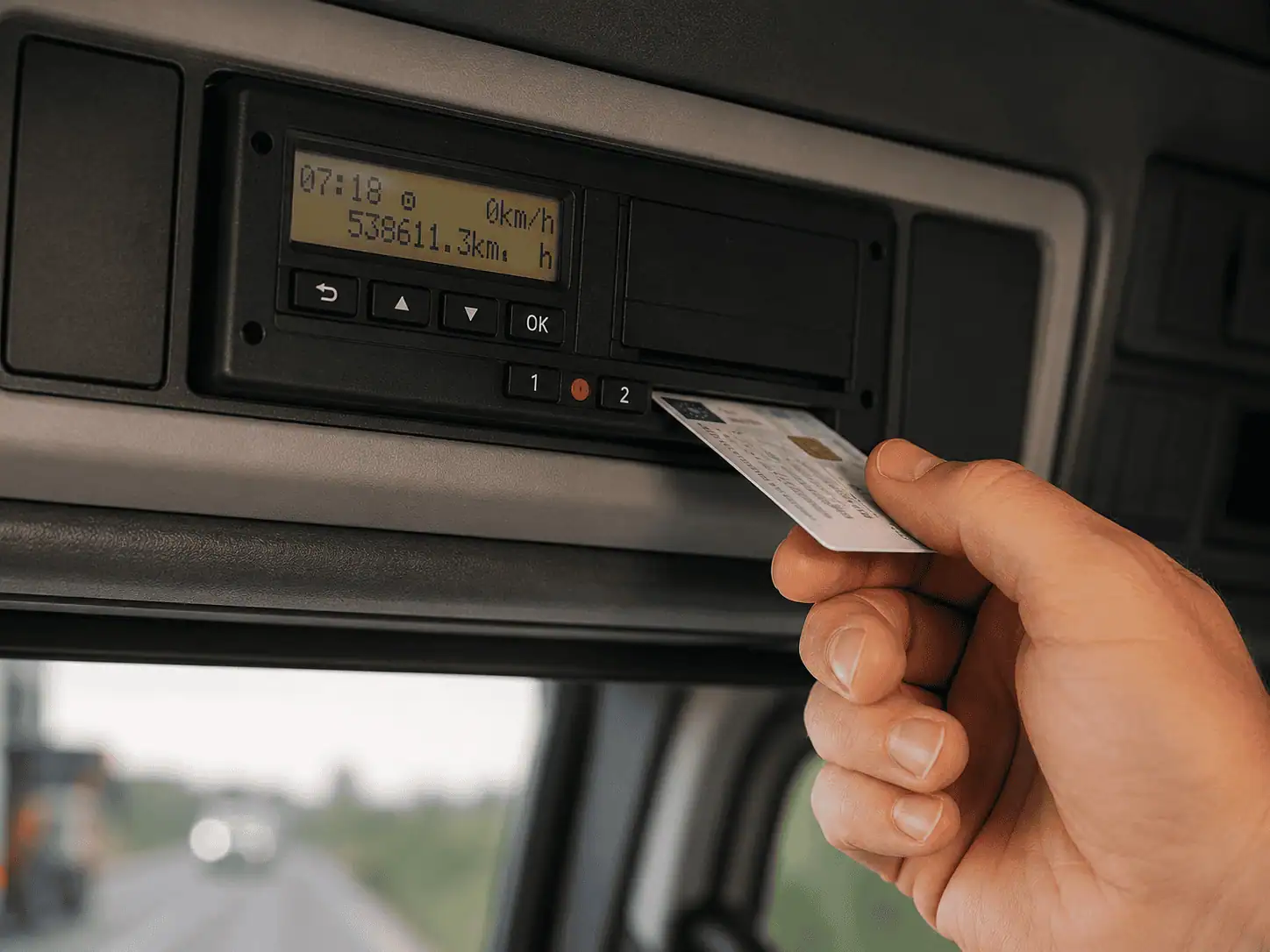
New European Union rules, effective from July 1, 2026, will significantly change working conditions in international van transport. As is already well known, under the requirements of the Mobility Package, light commercial vehicles (2.5–3.5 tons) from that date will have to be equipped with second-generation smart tachographs, while drivers will have to comply with precisely defined limits related to driving time and mandatory rest periods.
The light transport sector will thus face one of the largest regulatory changes of the past decade.
The obligations are not only financial — both companies and employees will have to adapt organizationally and learn. For many companies operating large van fleets, the biggest change will not be the installation of tachographs itself, but the complete system of monitoring drivers’ working hours, controlling mandatory rest periods, keeping records, etc. Let us also not forget the application of regulations concerning van drivers working abroad (rules on posted workers, etc.). Drivers, on the other hand, will have to know how to operate the tachograph, use the driver card, etc.
Who do the obligations apply to?
First of all, let us recall that this — as well as other provisions of the Mobility Package — applies to business entities registered in European Union member states.
The rules apply to light commercial vehicles with a total weight between 2.5 t and 3.5 t (single van or van + trailer combination — the total weight of the combination counts), used for commercial international transport or cabotage.
It is crucial to emphasize that the regulation covers not only fleets of new vehicles, but also vans already in operation, which will also have to be equipped with second-generation smart tachographs.
The obligations do not apply to own-account transport, domestic transport within EU countries, municipal service vehicles, special-purpose vehicles, and similar cases.
The introduction of tachographs in vans is the final item in a series of measures in this field defined by the provisions of the Mobility Package. The process of transformation and transition to second-generation smart tachographs for truck transport began during the summer of 2023. Initially, only newly manufactured vehicles were covered, and over time, through several phases, installation/replacement became mandatory for all vehicles over 3.5 tons engaged in international commercial freight transport (old and new, including those equipped with first-generation smart tachographs).
Working hours of van drivers: the same as for their colleagues in trucks
From July 1, 2026, van drivers covered by the new regulations will have to comply with the same basic limits on driving time, breaks and rest as their colleagues driving trucks:
- Maximum daily driving time of 9 hours (with the possibility of extension to 10 hours twice a week),
- Maximum weekly driving time of 56 hours, and a maximum of 90 hours over two consecutive weeks;
- Mandatory breaks of at least 45 minutes after no more than 4.5 hours of driving (with the possibility of splitting into shorter breaks),
- Mandatory daily rest of at least 11 hours, with limited exceptions;
- Mandatory compensation of rest in prescribed cases.
Non-compliance may lead to serious financial sanctions. Violations of tachograph usage rules or social regulations (e.g., shortening breaks or rest periods, improper recording of data) are subject to very high administrative fines, which accumulate and can reach several thousand euros.
Van carriers, are you ready?
In practice, van carriers are currently going through a transformation similar to the one their colleagues with truck fleets experienced over the past two years. So, are they ready?
Logistics professionals in Poland — one of the largest “transport powers” — wrote in the middle of last year that the controversial point was the high cost of the tachograph itself and its installation, which can cost 3,500-4,700 EUR per vehicle, which, combined with other costs (such as purchasing software, employee training, etc.), along with limited driver working time, can seriously threaten the profitability of small enterprises in particular.
Truth be told, the transport industry itself has repeatedly shown that it is not overly agile. Companies often wait until the last moment to comply with regulations, postponing equipment installation and counting on the authorities to postpone enforcement.
For example, in April 2024, the Spanish association Fenadismer reported that only 10% of the total number of buses and trucks required to switch to G2V2 had done so. At that time, about a year remained until full enforcement of the obligation.
The Spanish were, of course, not the only ones, and problems and delays were reported in most European countries. To be completely honest, carriers were not solely responsible for part of these issues: suppliers struggled with parts, states did not provide a sufficient number of authorized workshops… Associations continuously appealed for postponement of implementation. In the end, that is what happened, and after a grace period and adjustments (and much speculation), the penalizing of those who did not have G2V2 in their truck or bus began only in March last year. Fines of several thousand euros were imposed, and in some cases companies temporarily “lost” their trucks. For example, a Czech company ran into trouble near Dresden in the very first days — in addition to a fine of €1,500 (for a first-generation smart tachograph that had not been replaced), the truck had to remain in service and wait its turn for installation. And the waiting list was long…
When it comes to van carriers, the situation, at least publicly, seems somewhat different. It appears that, at least since the beginning of 2026, there have not been too many loud complaints about the obligation awaiting them in just a few months. This can mean only two things: they have learned from the “big wheels” and are already preparing extensively, or, like Scarlett O’Hara, they will “think about it tomorrow.”