Today, the Brenner Pass case significantly impacts international logistics and trade flows across Europe.
On one side is the stance that the free movement of goods is a fundamental principle of the European community. On the other, Austrian authorities strive to protect their citizens and the environment from increasing truck transit through the Alps. Reconciliation between these views seems far off, and the case has even reached the Court of Justice of the European Union.
A Key Route
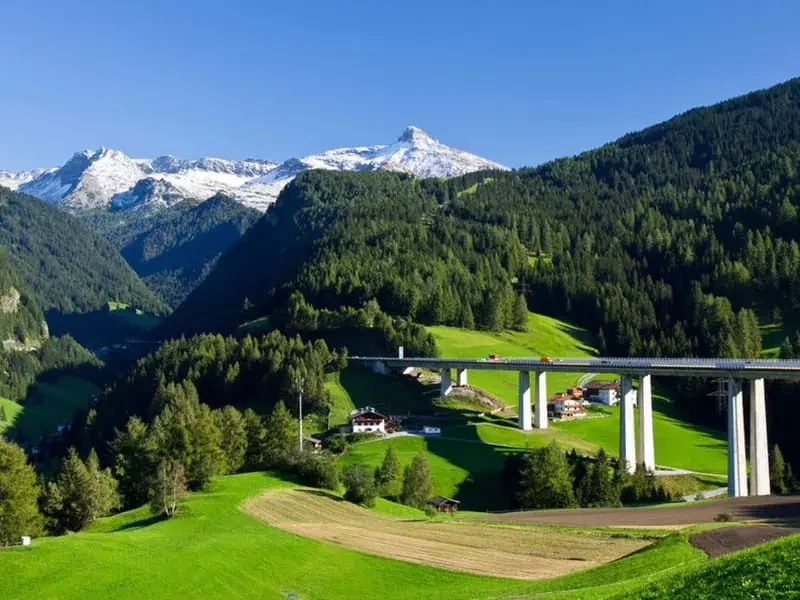
The Brenner Pass is a key transit route between Italy and Austria and serves as a lifeline for mobility along the north-south axis of Europe. Over 2.4 million trucks pass through this route annually, and the number is steadily rising.
Restrictions on the transit of heavy goods vehicles through the Alps include various measures: night driving bans, bans on specific types of cargo, Saturday winter bans, as well as so-called block checks—specific days when truck crossing is limited to 300 vehicles per hour.
Many countries have criticized these traffic restrictions (Hungary, Czech Republic, Germany…) since the first plans were introduced, but Italy — whose exports heavily rely on the Brenner — has taken its complaints the furthest.
How Much Do the Bans Cost?
In recent years, businesses from neighboring countries have expressed different views on how much these bans, delays, and wait times are costing them.
One of the most recent estimates came from the Italian Ministry of Transport in early February, which reported that the restrictions at the Brenner have cost Italy’s transport sector as much as €1.8 billion over the past five years. Italians argue that these restrictions bring minimal environmental benefit. As an example, they point to night driving bans causing traffic jams later in the day, which lead to more pollution than fast-moving trucks.
Germany’s Federal Association of Freight Transport and Logistics (BGL) has also repeatedly pointed out that Austria’s measures negatively impact the economy, particularly small and medium-sized transport companies and truck drivers.
Claiming that the restrictions violate the rules of free trade and the free movement of goods within the EU, Italian authorities have officially initiated proceedings before the Union’s institutions — filing a complaint with the European Court of Justice in mid-2024.
Italy has, in the meantime (some might say “finally”), secured support from the European Commission in this process. Despite numerous written appeals from various transport associations, chambers of commerce, and even the International Road Transport Union (IRU), the Commission long resisted involvement, insisting on negotiation and the view that bordering countries must resolve transit issues together. When it was announced last year that the Commission would support Italy’s lawsuit against Austria, much of the transport sector saw this as a major victory for Rome.
Counterarguments: Public Health and Rail Freight
Austria, on the other hand, argues that the measures it implements are crucial to protecting the sensitive Alpine environment. Due to high emissions, the Alps and surrounding regions frequently exceed pollution limits. The aim of the restrictions is also to encourage the shift of freight transport to rail and promote greater use of RoLa (Roll on-Roll off) lines (trucks transported by train).
One of the key projects supporting Austria’s policy is the Brenner Base Tunnel (BBT), currently under construction, which will enable greater freight transport by rail. The BBT is expected to be operational by 2032 and will allow for the transfer of up to 50 million tons of goods annually from road to rail. The new tunnel will increase freight train capacity, improving the competitiveness of this mode of transport.
As for the case before the Court of Justice, Austria has defended its position by arguing that excessive traffic endangers public health. Italy had until March 31, 2025, to submit its response to this objection. At the time of writing, their reply was not yet known, but there is no doubt that this information will soon become public.
If the court rules in favor of Italy, Austria could face sanctions such as daily fines or lump-sum penalties — but that still does not guarantee that this Gordian knot will be untangled quickly or easily.
Additional Restrictions
To make matters even more complicated, starting January 1 of this year, due to construction work, the Lueg bridge on the Brenner motorway is limited to one lane in each direction. The only exceptions are weekends and high-traffic periods when two lanes are open.
Austria’s road infrastructure authority — ASFINAG — presented preliminary findings after two and a half months of this restriction, stating that the temporary system is functioning well and that only slightly longer delays were observed, and only during certain hours. As expected, such a report has further fueled frustration from the “opposing” side.