For transport companies, the ideal is clear: full cargo space, in any direction – or simply put: always enough goods to transport. However, finding suitable loads to avoid empty runs often proves to be quite a challenge.
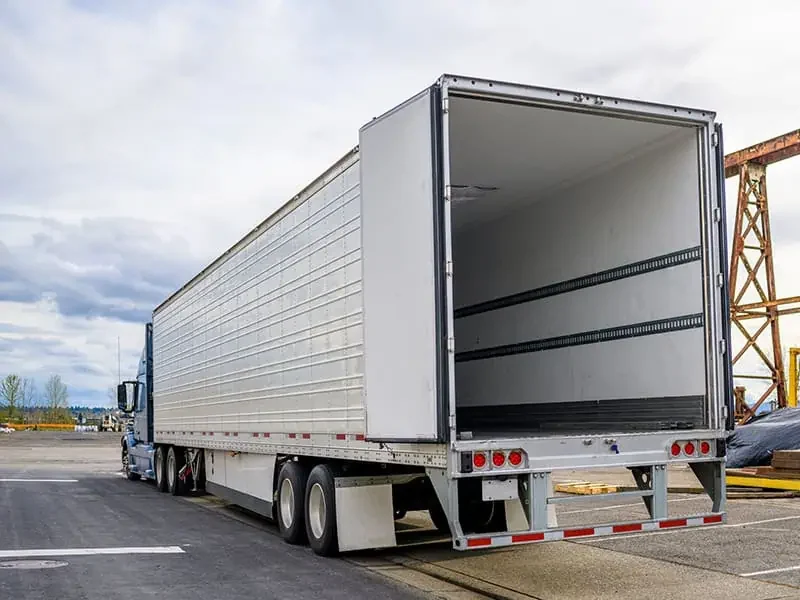
An empty run refers to a situation when a freight vehicle covers a certain distance without any cargo, most often returning after delivery or heading to pick up new goods. Avoiding empty runs is crucial for reducing costs, increasing efficiency, and lowering environmental impact.
Statistics show that empty runs are more common than expected: according to Eurostat data, in 2024, around 21.6% of the total mileage of road freight vehicles in the EU was driven empty. Even if we ignore the lost profit, just imagine how many tons of CO₂ were unnecessarily emitted this way!
Domestic Transport More Affected
The analysis by the European statistical agency reveals that empty runs were more frequent in domestic traffic (25.8% of the total mileage), while international road transport in 2024 recorded them at 12.6%.
In most EU countries (17), the share of empty kilometers ranged between 15% and 30%. The highest was in Cyprus – as much as 43.7%. Experts explain that this is a consequence of high import volumes through ports, as well as transport in the construction industry, where vehicles often run empty in one direction. Ireland (34.7%), Greece (34.4%), and Austria (34.0%) also stand out in this respect. On the opposite side are Denmark with only 7.5%, Lithuania with 11.0%, and Belgium with 11.6% empty kilometers.
Almost all countries record a higher share of empty runs in national than in international transport. Exceptions are Denmark and France. When looking at international road transport, more than one-fifth of empty truck mileage was recorded only in Austria (22.3%), France (21.0%), Luxembourg (20.9%), Ireland (20.5%), and Germany (20.2%).
How Not to Drive Empty?
Most strategies to optimize capacity utilization and make the best use of your resources may sound familiar, but it doesn’t hurt to be reminded. This is especially important if you are new to the business (so every tip is valuable), but also useful for experienced players who sometimes overlook the obvious.
Here are some tips that can help you:
Better route planning with modern software tools
Transport management software solutions help you plan routes more efficiently and improve communication, which reduces the number of empty runs. Monitoring route data, load capacity utilization, costs, and waiting times will allow you to identify the most problematic sections – and then seek ways to replace or improve them.
These solutions are advancing rapidly, and as a client, you get additional options. Keep track of the market and stay informed about what is being offered to carriers so you can decide what best suits your needs.
Expanding partnerships
Consider backhaul agreements, i.e. signing contracts with companies that have goods to transport from the area you would otherwise return empty from.
Backhauling is a transport strategy where the truck, after delivering goods, does not return empty but picks up additional cargo on the return route. Although coordination is more complex, the benefits are significant: costs are reduced, efficiency increases, and customer service improves. The simplest way to implement backhauling is through stable, recurring routes where trucks regularly return with return loads from steady partners to the same destinations. This way, return trips become profitable, and the number of empty kilometers is significantly reduced.
Also, consider joining partner networks or cooperatives that connect you with other carriers and allow capacity sharing.
Using freight exchanges
Online freight exchanges provide many options for finding nearby loads. Be as active as possible.
As with the above, the rule here is to stay informed and follow what the market offers. Alongside major players (such as Timocom, Trans.eu, etc.), it’s worth giving newcomers a chance and trying out new freight exchanges (which, truth be told, sometimes pop up like mushrooms after rain). There is no guarantee you’ll find work there, but it’s certainly worth a try.
Cooperation with major logistics companies
Large logistics providers usually ensure steady cargo flows, as they handle continuous shipments on the same or related routes. Working with major players can mean optimizing loads and routes on a larger scale, which is undoubtedly beneficial for your business.
Join thematic groups on social media
This may seem like a “manual” effort, but the truth is that for many, especially small carriers, it can be a useful part of the puzzle. Personal contact is still important, and it’s not a bad idea to connect with the community this way, as well as with clients who often look for carriers through these channels. Every country has its “favorite” social network, so explore and join groups and communities where routes are offered.
In addition to following diligently and trying to find opportunities for yourself, make sure not to undercut others and undermine the industry by accepting economically unsustainable prices just to get a job. In the long run, that benefits no one.